

U.S. and Israel Conduct Airstrikes on Iran to Curb Nuclear Ambitions

U.S. and Israel Execute Airstrikes on Iran's Nuclear Facilities
Updated June 22, 2025 at 1:12 AM EDT
The recent military collaboration between the United States and Israel has led to targeted strikes on key Iranian nuclear sites, escalating tensions in an already volatile Middle East. The objective of this operation is to hinder Iran's nuclear development efforts, with specific attention given to the fortified Fordow facility.
President Trump confirmed the successful execution of the mission via a post on Truth Social, stating, “We have completed our very successful attack on the three Nuclear sites in Iran, including Fordow, Natanz, and Esfahan.” He assured that all aircraft had safely exited Iranian airspace after completing the strike, expressing optimism for lasting peace and commending the military's precision.
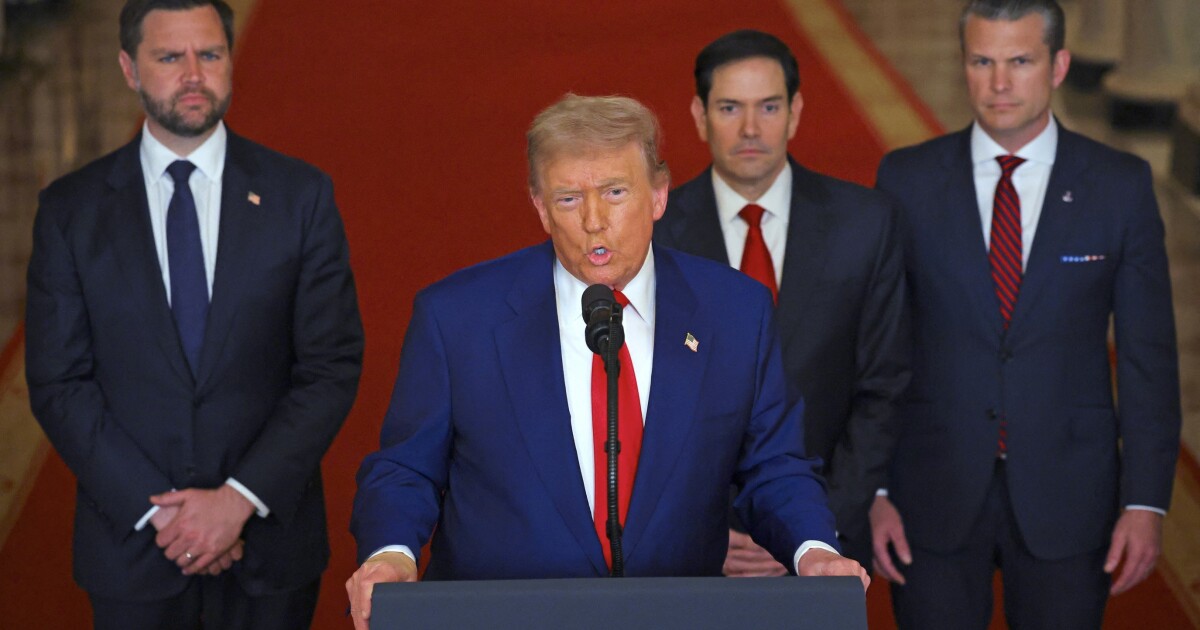
During a presidential address from the White House, Trump, accompanied by key administration officials including Vice President Vance and Defense Secretary Pete Hegseth, hailed the mission as a “spectacular military success.” The operation was described as a dramatic blow to Iran's nuclear enrichment efforts.
In regards to potential future actions, Trump noted, “If peace does not come quickly, we will go after those other targets with precision, speed and skill.” He planned a press conference at the Pentagon for further announcements, scheduled for 8 a.m. ET on Sunday.
This military intervention marks the first direct engagement by U.S. forces in the ongoing conflict between Israel and Iran. The strikes targeted Fordow, located approximately 100 miles south of Tehran, which has posed strategic concerns for Israel. The strikes utilized specialized "bunker buster" munitions, such as the GBU-57 MOP, delivered by B-2 stealth bombers, as urged by Israeli officials.
While a U.S. official stated that senior Democratic leaders were informed of the strikes prior to Trump's announcement, details surrounding the notification of Republican leaders remain unclear.
The military action has faced criticism, notably from Rep. Jim Himes, who contended that Trump's order to engage militarily without Congressional approval constitutes a violation of the U.S. Constitution.
Shifts in U.S. Policy Towards Iran
Despite previous commitments to avoid deepening military conflicts in the region, Trump underscored the urgent need to eliminate any possibility of Iran acquiring nuclear weapons. Although his administration initially aimed to renegotiate the nuclear agreement abandoned in 2018, policy direction shifted following recent Israeli airstrikes on Iranian targets.
In a continuation of his assertive rhetoric, Trump has demanded Iran's “UNCONDITIONAL SURRENDER!” and emphasized U.S. air superiority. He has also publicly addressed Iran's Supreme Leader Ayatollah Ali Khamenei, indicating awareness of Khamenei's location while suggesting that an immediate attack is not planned at this time.
In a response, Khamenei warned on X that the U.S. would face serious consequences, stating, “The harm the US will suffer will definitely be irreparable if they enter this conflict militarily.”
Future Implications of the Conflict
President Trump has ruled out the deployment of ground troops in Iran, yet the recent airstrikes open a new chapter of uncertainty in the region. The hostilities have escalated following Israeli airstrikes deemed necessary by Israel to neutralize what it perceives as an existential threat posed by Iran.
While Israel insists its military actions are targeted solely at nuclear and military installations, Iranian reports indicate over 200 civilian casualties as a result of these strikes. In retaliation, Iran has launched missile and drone attacks against Israel, inflicting casualties according to Israeli sources.
Although Iran maintains that its nuclear program is intended for peaceful purposes, Israeli Prime Minister Benjamin Netanyahu claims it remains a significant danger to both Israel and the U.S. U.S. intelligence previously assessed that Iran halted its efforts to develop nuclear weapons in 2003, but Trump has expressed skepticism, suggesting that Iran is closer than ever to acquiring such capabilities.